Showing posts with label Jesus. Show all posts

Wednesday, June 9, 2010

One Big Mediterranean Village

Many Christians overlook Caesarea when they visit Israel. Caesarea is very interesting, but lets face it; when you have a limited amount of time and you came all that way for a religious experience, you can't afford to waste time. The bottom line is that Caesarea is about Rome, not about Jesus.


The Roman Empire was something new and different in this neck of the woods. (That’s why it's called the 'Classic Period' and not 'Ancient History'.) It's not as if the Romans were imaginative or inventive. Romans weren't original. They conquered other people and hijacked their resources and ideas and civilizations, and by fusing those cultures they produced a new society. The sea had always served as a barrier, a natural defense between nations, but once it was a Roman sea, the Mediterranean was transformed into a conduit of goods and information connecting diverse cultures from the farthest corners of the known world. Perhaps not today's 'global village', but certainly one big 'Mediterranean village' and the only village around.
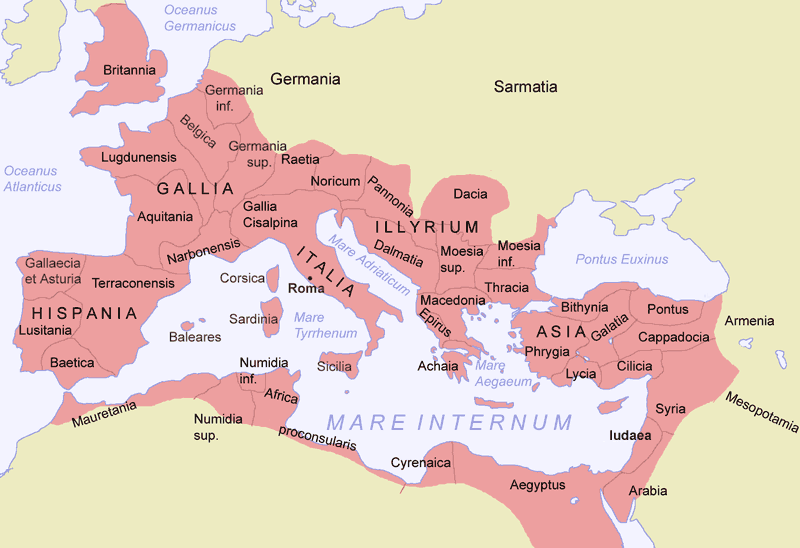

When you think about it, it's odd that Rome left such a significant mark on little far away Israel. Yet by far there are more Roman ruins and artifacts here than from any period before or after. Even the sites most identified with the holy land are actually Roman. The Wailing Wall – Roman; Al Aqsa, on a Roman built forum. So how did Rome come into ownership of the land of Israel?

To answer that, one must understand family dynamics. When my little brother Barry and I were kids we would fight over stuff. The rule was that if we took it to my mom, then no matter what it was, no matter who was right, my mom got it. That's how we learned to always settle things between ourselves and to never bother my mom.

In 67 B.C. the Hasmoneans ruled Judea. Two Hasmonean princes with funny names, Hyrcanus and Aristobulus, got into a big fight over which one would get to be the king. Their mom was deceased, so the boys unwisely took the matter to the next best thing - Pompey, the Roman governor of nearby Syria. Naturally Pompey knew all about my mom's rule, so since the kids couldn't play nice, Pompey (in the name of Rome) got the kingdom.

Pompey let his good friend Antipater the Idumean administrate Judea. Antipater had been a pagan, but converted to Judaism, so the Romans figured it was a good fit. Jewish enough to relate to the Judeans, but pagan enough to serve his Roman masters.

Antipater was succeeded by his son Herod the Great, so called to tell him from his little known cousin, Herod the Loser. Herod (the Great) was determined to integrate his new kingdom with Rome's Mediterranean Village, and to do this he needed a deep sea harbor. The only problem was that the east Mediterranean coast running north from the mouth of the Nile until modern day Haifa is devoid of natural harbors. Until then, all the ports in ancient land of Israel had simply been river inlets to the sea.

Not one to be thwarted by geology, Herod chose a most unlikely site. As a rule of thumb, all cities in ancient times were founded near fertile land in order to feed the population, a source of water and on a site that can be easily defended. Herod picked a flat spot of beach real estate surrounded by sand dunes to build the city he would call Caesarea.


Most histories claim that Herod built Caesarea. This is not true. Herod was much too busy in his palace cooking up schemes to murder his family and baby Jesus. Slaves and Roman engineers built Caesarea. Using the latest in Roman technology, they built breakwaters out into the sea laying cement that sets underwater, producing Sebastos, the largest artificial harbor in the Mediterranean. The city was to be a hub of commerce, so lack of nearby farmland was not an issue – they would buy food. Diverting subterranean water reservoirs with a system of shafts and tunnels in the Carmel mountains 20 miles away, they were able to flood a dammed up coastal plain of almost 2000 acres, thus producing enough pressure to transport water by gravitation in aqueducts to the city center. As for fortifications, Caesarea's defense was a good offence – a staging point for legions to crush any potential threat.
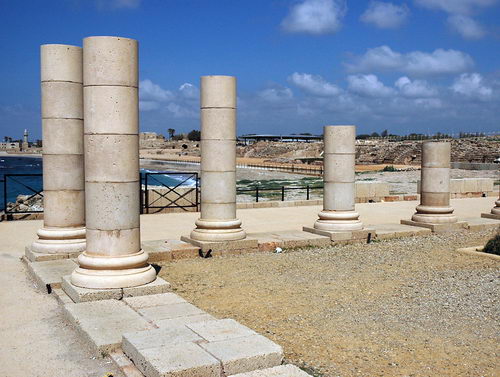
Romans weren't all work and no play. An amphitheater large enough to hold horse races (seating an estimated 5000 spectators) was built along the beach, and a theater added to the south, facing the sea (Later to be abandoned; the view is breathtaking, but in the afternoons until sundown the audience is blinded by the setting sun. Eventually a new one had to be built facing north. Wonder what became of the architect responsible for that snafu….) Herod's palace was built on a promontory jutting out into the sea, complete with swimming pool surrounded by a portico. The palace was located so as to be within visual contact with the port, amphitheater and theater. Much like a laptop, the king and Roman procurators that succeeded him could monitor their investments in real time, or flip over to the latest diversion – all from the comfort of home.

Caesarea was a modern concept and it worked. The only major port on the southeastern shore of the Mediterranean and on the crossroads of the Via Maris, it funneled goods from east to west, and legions from west to east. Within a century it replaced Jerusalem as capital of 'Provincia Palesina" after Jewish Judea had been crushed.

With trade flourishing in the Mediterranean and an efficient network of roads, there was a revolution in communications – suddenly people on opposite sides of the empire were only a message away.


CaesarChat, 33 A.D.


Tiberius wrote: Hey, PP - what's up?
(2 months later)
Pontius Pilate wrote: Not much, Tibi. Galilean noob says he's Messiah. lol
(2 months later)
Tiberius wrote: Messiah???
(2 months later)
Pontius Pilate wrote: Jewish king lol
(2 months later)
Tiberius wrote: kill him
(2 months later)
Pontius Pilate wrote: did that, but he's alive again lol
(2 months later)
Tiberius wrote: OMG
(2 months later)
Pontius Pilate wrote: U reckon?


A dedication carved in limestone was found in the theater mentioning Pontius Pilate, one of the few pieces of physical evidence supporting the story told in the New Testament. But this is only a subtle hint to the role Caesarea played in the Christian story. It was from here that the baton was passed from an underground sect of Jews to the nations.
.


.
Saint Peter was sleeping on the roof one day (As one who lives in sunny Israel, I find that in itself a miracle.) when an angel appeared and laid out a spread of clam chowder, fried shrimp, sizzling bacon and cheese burgers - all yummy, none Glatt kosher. "Dig in," commands the angel. (I often go up on my roof hoping to see this angel, but it seems his appearances are limited to Reform Rabbis.) Obviously, there was only one thing to do after a miracle like this – go report it to Cornelius, the Roman commandant in Caesarea. It took no more than putting tref on the menu to convince Cornelius to convert to Christianity, and the rest is history.

Caesarea was the launching point of Christianity. From here the apostle Paul set out to spread the gospel, where he preached to Agrippa, and where he was imprisoned and wrote his epistles until sent to Rome.

If Jesus would have arrived at any time prior or any place other than Rome's Mediterranean village, his message would have stagnated in a local Judean backwater. But ironically, the very empire that sought to suppress the new faith facilitated it. Christianity traveled the same arteries of commerce that sustained Rome, new congregations networked on Imperial lines of communication, and words could never have been more convincing that the living object lessons of martyrs in the arenas, produced and directed by Rome.


So while Israel is the cradle of Christianity, the Mediterranean village was its playground. In Caesarea you see the port from where the word was spread to every nation, the courts where saints defended their faith and the arena where they paid the price. It's all there.


If you want to understand Christ, you have to see Israel; if you want to understand Christianity, go to Caesarea.

Saturday, January 16, 2010

Transfiguration

In Israel where half the enlisted men are women, the old cliché "I ran into an old army buddy" doesn't always mean a reunion of brothers. Once upon a Yom Kippur, I was a young Israeli soldier pulling guard duty on a base near Haifa. Left behind while our comrades were fasting with their families, we unhappy few sat at the gate to pass the time. A girl (soldier) became the center of attention. And not (only) because of her feminine wiles - which would only be natural, her being the only female stuck on base with a bunch of lonely young men. No, she had something much more interesting, more mysterious, going for her. She had Jesus.

Her name was Melody. Between snacks, a few self appointed defenders of the Jewish faith were poking fun, although not successfully, as their ignorance of her faith, not to mention their own, was painfully obvious. Nonplussed by her tormentors, Melody was radiant, even cheerful. Maybe that's why I remember her 25 years later. Her warmth. Heat.

I grew up in the Church. I'd heard it all before, and it left me cold. For me, Christianity was an institution, churches, theology, rules. So her message wasn't new to me, but I was impressed by her delivery.

25 years later, Melody is a guide to Christian holy places. Naturally, I was curious. Is she still a believer? No, she laughed, but it’s a good living.

She met us at the Catholic Church on Mount Tabor. No trouble finding it. You can't miss it; it's just next door to the Greek Orthodox church. Mount Tabor is where 'The Church' claims Jesus took Peter, James and John to witness His transfiguration, which was a cosmic coming out of the closet, with Moses and Elijah making a cameo appearance. The disciples, who had always suspected that Jesus had divine tendencies, were nevertheless taken back.


Peter was psyched. "Hey Jesus, lets build three tabernacles up here for You and your friends!"
Jesus was less than excited about the idea. "I don't know…."
But Peter was on a roll. "You're right. Why think small? Tabernacles won't do. We'll build a huge church right here on top of the mountain. People will see it for miles around and come from far and wide, from all over the world! Just think of the tourist income! Think what it will do for the local economy!"
Jesus: "Peter, you're starting to sound like Judas."
Moses (to Jesus): "What's going on? Nobody said anything about this when they told me to come down here!"
Peter: "If we make the church big enough, visitors will be able to celebrate mass!"
Moses: "Mass?"
Jesus had heard enough. "We're finished here, guys. Let's go!"
Moses and Elijah headed on up to heaven while Jesus hustled His favorite disciples back to join the others – but not before reminding them to keep His little secret. Peter promptly posted it on his blog.

Melody says that Mount Hermon looks like a more likely candidate than Tabor for the mountain where Jesus was transfigured, but the Catholic Church owns real estate on Mt. Tabor, so that's where they built the Church of the Transfiguration. Inspired by St. Peter, the Italian architect Antonio Barlucci designed the church to appear like three (very fancy) tabernacles, with two small ones on either side of a big one (for Jesus, of course). The ceiling over the sanctuary is inlayed with alabaster to create an effect of heavenly light streaming down on the worshipers celebrating mass, but has been covered with a lead dome because the alabaster roof turned out to be leaky.


The village of Cana is where Jesus performed His first miracle by turning ordinary water into fine wine. Today the locals turn cheap hooch into tourist dollars. The Roman Catholic church is right across the alley from the Greek Orthodox one. The reason that you find so many holy sites with Catholic and Orthodox churches next to each other isn't because Greeks and Catholics like each other so much; it's more like McDonalds and Burger King setting up shop in the same food court at the mall. Pure and simple, its good ol' fashioned American competition.

In Nazareth, St. Gabriel's (Greek Orthodox) marks the place where Mary became the first virgin in history to test positive with a home pregnancy kit. Unlike Catholics, who clutter their churches with statues, Greek Orthodox churches have icons. Icons are simply 2 dimensional versions of Catholic images which can best described as saints who have been run over by a steamroller. These icons have nothing whatsoever to do with the icons you see on the Internet. Everyone knows that images on the net are creations of the Geek Orthodox Church.


The Catholic Church of the Annunciation is a short walk down Main Street from (you guessed it) the Greek Orthodox establishment. Its all about Mary at Annunciation. It reminds me of the joke about the proverbial fat girl in 3rd grade – she was so big that no matter where you sat in the classroom, you ended up sitting next to the fat girl. Melody pointed out the Mary mosaics on the walls,


Mary statues on the walls,


Mary in the fountain,


Mary on the door, and so on. You can't avoid Mary at Annunciation. (They also worship Jesus. He's the baby being cradled by some of the Marys.)

Melody finished the day at a rather neglected church crammed between vendors' stalls in the market which (they say) is the synagogue where Jesus prayed. It was the only place we visited where I thawed a little. Maybe because it wasn't just another grand monument to human creativity and endeavor; maybe because it was the only place that took us back to Jesus' Jewish roots.

Churches still leave me cold, but in 25 years I've warmed to Jesus. So it’s a bit ironic meeting Melody again. "Back then, I loved the story about a God who loves us so much," she recalls. "I wanted it to be true, so I believed it." Now she's not sure if Jesus ever existed. Still, when she talks about churches and their stories, its with warmth. I guess she's just a warm person.

When we started the day on Mount Tabor, Melody explained that "transfiguration" is a change in perception, how someone is percieved, not a change in being. Jesus didn't take on a different form on the mountain, rather his disciples saw Him for who He is. For 25 years Melody had existed in my mind as the glowing, red hot follower of the Messiah. But Melody isn't a memory, and in the course of that day she was transfigured back into person. A person with a life, a human being who's on a journey and has yet to arrive. But for at least for now, I see her for who she is.

A lot of things change in the space of a life time, so I guess it shouldn't be surprising that after 2000 years the Church that erupted with a simple, beautiful story about God's love has frozen solid into an icy institution carved by men. I don't think that Jesus has been transformed by the Church, but there has been a definite change in how He is presented and perceived.

Kind of like a transfiguration in reverse.
.

Monday, September 21, 2009

A Journey Through Society

(I posted "A Journey Through Society" last year. It seems to me that now in the "Days of Awe" between Rosh Hashana and Yom Kippur that its message fits the season, fits what we have been studying and fits "Real Deep". My tenth graders below started 11th grade 2 weeks ago.)


My tenth graders set off on a journey last week. It's not the first time they've been in Tel Aviv or Jerusalem, but this time they visited places and people that perhaps they had heard of, but could barely imagine. They traveled to the farthest corners of Israeli society; dark places most of us Middle Israelis never see.

And the first step was a question: If on one side is equality and on the other is 'survival of the fittest', where are we Israelis? Part of the answer is a rundown neighborhood in south Tel Aviv ironically named Shikunat Hatikvah ('Neighborhood of Hope'). Our guides did their best to to explain what it's like to live in an island of poverty in a party town like Tel Aviv, but they weren't nearly as convincing as the locals we met by chance. "It's not as bad as they say it is", they explained, but the subtitles read otherwise.
.

.
A few streets over is a slum that doesn't appear on the map, but has a name – 'Crate Town' (my translation). Not recognized by the authorities and therefore free of building codes and municipal services, people build their homes out of odds and ends. Pitch dark at night, flooded in winter and ruled by criminals, the people living here probably would have been left to their own devices except that to their misfortune they are sitting on some of the most valuable real estate in the country. Rich contractors buy up the ground from under their feet turning them into squatters on land they have lived on since the nation was founded. The rich getting richer use a combination of goons and city ordinances to force the poor getting poorer out of their homes.


Our next stop was the 'slave market' near the Central Bus Station. The street is a kaleidoscope of human beings of all colors and races, foreign laborers living on a pittance and often just one step ahead of the law. Exploitation draws exploitation – a few blocks over is the red light district (We didn't go there of course.)

A 15 minute bus ride away is Kikar Hamedina. It's Tel Aviv's Central Park, a circle of watered parks surrounded by chic boutiques that only the very wealthy can afford to shop. Again it was the passersby that underlined the message, casually mentioning how much they invest in the manicured dogs they're walking – more than what an entire family lives on in the neighborhoods we had been only minutes ago.

Walking back to the buses, I asked Odedah what she made of what we had seen that day. She's 16 years old, so learning that she was shocked didn't surprise me. She thinks that social justice has to start with people with money.

"Because people follow people with money."
"Do you have money?"
"No."
"Neither do I."

Oh well………….

We spent the night in a hostel in Jerusalem. An overnight school trip where we don't sleep in tents in the desert and have showers and teachers too tired to know or care what they're up to all night (see 'The Lowest Place on Earth'). The kids were very excited.

The next morning we invaded an ultraorthodox stronghold called Mea Shearim. I use military terminology because that is how the people living there see us creatures of modern society – the enemy. They reject modern culture, modern kids and the modern state that spawned them. They say that only the Messiah can redeem the Jewish nation in the promised land. The state of Israel is an abomination. We were asked not politely to leave.

Something odd occurred to me. Our guides were obviously not religious. That's why they wanted us to see the nasty side of religious Jews. Yet, for two days they were preaching about equality and social injustice.

There are two explanations for everything in the world. The first is called evolution. By random chance and natural selection, things are what they are. Survival of the fittest. The other, less popular, notion is creation. God created stuff for a reason.

Now if you believe in evolution, then the strong survive. There's no way around it. And if you believe in equality, then it's because we are created beings. There is a God.

So I thought it was odd a bunch of people trying to show us that God is bunk, but talk equality – and a another bunch of people that think they are better than everyone not like them, but talk God. I know there's some rational explanation, but I just thought it was odd, that's all.

Nevertheless, after two days of seeing poverty and crime and exploitation, I was wondering if those snobs in Mea Shearim aren't right. Maybe Israel is an abomination.

The plan was for my tenth graders to finish the day on Mt. Herzl, where the dreamer who wrote the blueprint for modern Israel is buried. They are 16 or almost 16 now, and the idea was to give them their identity cards in a ceremony at a place symbolic of the society they will be joining before long.


But once again, something not on the program underlined why we need Israel, warts and all. Just before loading the buses taking us to the ceremony, one ambulance siren, then a second, then dozens. In Jerusalem, that can mean only one thing. Terror. Another Palestinian that hates Jews more than he loves his own life.

Israel hasn't succeeded any more than the rest of the family of man in establishing a just society. But time and again, the world has turned on Jews, and providing a haven, not social justice, is why Israel has to exist.

On the way back home I remarked to Odedah that our journey reminded me of the Gospels. I mean, Jesus was on a journey in society. He rubbed shoulders with the poor, broke bread with the rich, was rejected by religious hypocrites.

"You know, like, not much has changed here in 2000 years."

"And it won't until He comes back", she replied.

I doubt if human beings will ever be able to create a just society. I know that Jesus didn't even try. He didn't come with a social agenda; He didn't come to change mankind. He came to save men.

So in a way, as much as I hate to admit it, they're right in Mea Shearim.
Redemption will come with Messiah.

Tuesday, August 4, 2009

Sunday School

When I was a kid, we used to compete at Sunday School to see who could memorize the most scripture by heart. Besides John 3:16, the all time favorite was John 11:35, "Jesus wept." The shortest verse in the Bible; only two words. A freebie.

It's about how a friend of Jesus, Lazarus, gets sick. His sisters run off to fetch Jesus, but by the time Jesus can get away from the Messiah business, poor ol' Lazarus has died in the meantime. When Jesus finds out that his buddy Lazarus is dead, he's real broken up about it. "Jesus wept."

Now everybody is real impressed with the show of emotion, but his friends take Jesus aside. "You know, the sympathy is really nice, but you being the Messiah and all, we were hoping for a little more." Jesus takes the hint and then and there raises Lazarus up from the dead. Once again, Jesus saves the day and everybody's happy. (Especially Lazarus and his sisters.)

All this happened a few years before the rebellion against Rome. It didn't go well for the Jews, and Jerusalem didn't fare any better than
Gamla and the rebels in Galilee. The Romans took their sweet time and then finally stormed and took the holy city, destroyed the Temple and slaughtered anyone that had managed to survive the siege. Jerusalem was leveled, and then to add insult to injury, less than a century later the Romans founded a pagan city on the ruins and called it Aelia Capitolina. They built a temple to Zeus on the temple mount to rub in their victory over the Jews, and another temple to Aphrodite on Golgotha (Where Jesus was crucified.) to stick it to the Christians, who they liked only a little more than the Jews.

The Romans built fortifications for their new city Aelia Capitolina, included 4 gates – and no wall. Not only that, only one was at the entrance to the city. Another one stood half a kilometer north out of town and two more so called "gates" were in the city center. Our guide Nachum claims that this was something the Romans did to demonstrate power, but to me it looks like a bureaucratic snafu – someone budgeted for 4 gates and forgot to allocate funds for the wall. Despite my objections, Nachum maintains that the Romans did this all over the empire, including in Rome. I counter that it only proves that they were consistently incompetent, no more. My friends duly noted Nachum's opinion and not mine because he claims to be one of the examiners for the exam to be certified. (But then, if he's inventing tales glorifying inept Romans, then it's likely that he's not above impersonating an examiner.)

Nevertheless, the city gate was very impressive. One main entrance was flanked by two smaller ones, and on the other side was a huge half circle plaza with a statue of the emperor or Zeus on a pillar. Today the Damascus Gate built by the Ottomans 500 years ago stands on the ruins of the Roman/Byzantine one, but you can still see one of the minor gates below serving as foundation for the 16th century one.

And then in one of those strange twists of history, the Romans converted to Christianity. Most people don't realize that the Byzantines were no more than the same mean ol' Romans that had simply switched from idols to icons. This brings us to the Byzantine period.

When you are studying the land of Israel in the Roman Period, Jesus doesn't figure in. He wasn't a player; working miracles and being the Messiah don't cut the mustard. But when you come to the Byzantine Period, it's a different story. A lot of things had changed since Lazarus rose from the dead.

One of the first things the Byzantines did was change the name of Aelia Capitolina back to Jerusalem. It was confusing for little Byzantine kids in Sunday School, memorizing Bible verses about Jerusalem and then the grown ups had to explain that it meant Aelia Capitolina. Changing the name back to Jerusalem made it a lot easier for everybody. Not only that, they built churches.

Now everybody knows that Constantine the Great was the first Byzantine emperor, but it's a little know fact that he never went to Sunday School. When he was a little boy he didn't have to go because he was a heathen, and even after he got saved he was just too busy running his empire business.

One Sunday morning his mom,
Helena, dropped by the palace.
"Constantine the Great, Sweetie, I think you should come to church with me this morning."
Constantine saw where this was going. The last thing he needed was for the palace guard to see him tagging along behind him mommy to Sunday School. In no time they would have him memorizing Bible verses.
"Mom, I've got a better idea. I think you should go to the holy land."

So Helena went to Jerusalem. She walked through the gate, took one look up at the statue of Zeus and told the city fathers to pull the dang thing down and put up something more appropriate to the city of our Lord. In a jiffy they had the statue down, sawed off the lightning bolt, and drilled a hole in its place and then inserted a golden staff. They shaved off the helmet and a sculptor chiseled away until it looked like long hair. By the time Helena left town, a statue of the Good Shepherd was standing on the pillar as good as new, without making a dent in the city wall fund.

Helena's mission was to find the very places Jesus had been, in particular the ones connected with his crucifixion, and to build churches there. She marched down the Cardo, which is Latin for "Main Street", and stopped smack in front of the temple of Aphrodite, which is Latin for Hustler magazine.

"Isn't this Golgotha?"
"Yes, ma'am." The town fathers blushed. (Who would have thought that the old bag was so well informed on holy places.)
"What in carnation is that abomination doing on the passion of our Lord?!!"
A few town fathers snickered.

Helena demanded that they tear down the temple, get rid of those outrageous statues of naked women and build the Church of the Holy Sepulcher. Someone dared suggest that if they left the statues it might be easier to get the kids to go to Sunday School. Helena wasn't amused.

Which brings us to my course in the 21st century. The subject for our day in the field was "Byzantine Jerusalem". This means for the most part going to churches, and being a Sunday, I couldn't help getting a little de je vu from my childhood years in Sunday School, but for most of my collogues church is about as familiar as the far side of the moon. (Somehow I got separated from the group at the Damascus Gate, so I headed for the Holy Sepulcher hoping to catch up with them. When I didn't find them there, I back tracked and found them in the museum that's under the gate. Miron, our course coordinator, asked me where I disappeared. I just shrugged. "I went to church.")
.
.
.
.
We took the Via Dolorosa, the same route Jesus was lead to Golgotha, to the
Church of the Holy Sepulcher. There are stations along the way marking every detail of Jesus' way to the cross.
.
If there is a time and place on earth that is the focus of the Christian religion, it's what happened here 2000 years ago. Its heart is an empty tomb. It has been embellished, and a dome built over it, but that's what it is. While ancient churches always were always oriented, pointing east, the Holy Sepulcher's basilica points west, towards the place that Jesus rose after 3 days in the grave.

One cannot but be impressed by the emotion, the awe, the passion, of worshipers from all over the world that make the pilgrimage. The sepulcher itself is covered with soot and wax, and the air a thick haze, from hundreds of candles lit around the base every day. It's as if an aura of holiness has been bottled and capped inside a grand Roman vestibule.

Yechiel, the other American taking this course, is an observant Jew. This was no doubt the first time he went to church. As we were leaving, he remarked that he can see why Christians that visit the Holy Sepulcher are moved.

I agree; no Christian can be apathetic, but not always in a positive way. I couldn't help but recall my brother Barry's remark after visiting the place: "This is the first time I've seen idolatry in real life." Barry's gut reaction to the religion the Romans created by dressing Jesus in the vestments of paganism is understandable. And anyone who's been to Sunday School knows that if Jesus is who he says he is, the last place you are going to find him is in a grave.

The last place we visited in Byzantine Jerusalem was in the parking lot of the Jewish Quarter in the Old City. Nachum pointed to a spot on the pavement and explained that we were standing on the northwestern corner of the
Nea, a church in honor of "The virgin Mary, mother of God" built by the Byzantine emperor Justinian. It had a sanctuary bigger than a football field and towered over the Temple Mount.

The Nea would have been just another VERY big church if taken out of context. Its location and size were no accident. One of the curiosities of Byzantine Jerusalem was that one vast stretch of prime real estate, the Temple Mount, was left in ruins purposely as witness to Jesus' prophesy that the Temple would be destroyed; that not one stone would be left on another. (Luke 19:41-44) Pious women all over the empire were asked to save the soiled rags after their monthly cycle and the church sent special deliveries of these "offerings" to be thrown on the Temple Mount. The Nea had no connection whatsoever to the life and ministry of Jesus; building a monument of grandeur to dominate the Temple site, and degrading the mount with refuse was a statement of the triumph of Christianity over the Jews.

Today the Nea lays under a parking lot. Jews park there.

Yechiel remarked about the Nea Church on the way home.
"They built this huge monumental church out of hatred, to humiliate the Jews and to one up the Temple. Was this what Jesus had in mind when he said that there wouldn't be one stone left on another?"

And my Sunday School lessons served me that moment. I recalled the story of how Jesus had come into Jerusalem a week before he was crucified. He came up over the Mount of Olives on a spring day, and as he made it over the top, the city was spread out before him in all her glory. He saw the Temple and the mansions around it. No doubt he knew that there were people there already plotting to take his life, and that same blind hatred would one day take them deeper, to murder one another while the enemy stood at the gates. He saw the Romans pulling down Jerusalem's Temple, raping her women and butchering her babes. He saw the abomination the Gentiles would make of her, and how one day they would built monuments of hatred in his name. Perhaps he even realized that the same Roman Empire that crucified him would twist his words and convince his people that he had planned all this.

That Sunday School story popped into my mind when Yechiel asked about Jesus' prophesy.
Did Jesus prophesy about Jerusalem in a spirit of spite and superiority?

"No", I said, "Jesus wept."
.
The name of this blog was inspired by a remark my brother Barry made once (about me).

Real Deep follows my journey in Israel. The idea is not just to visit places in the holy land, but to turn over the stones and dig under the surface and perhaps to discover what these places mean. To go deeper.

Real deep.